Educate Girls

Every last girl may want to go to school, but we know that a desire and an aspiration are not always enough. Deep in rural India, society doesn’t always support a girl’s education. Household chores, child marriage, restricted movement outside the house and patriarchy all stand in the way. The system also lets girls down -- secondary schools can be far away and re-enrolling after leaving education can be very difficult.


Educate Girls UK was founded in 2016 with a mission to work with local organisations in some of the world’s most vulnerable communities, to find and support girls back into education. We identified Educate Girls (FEGG), an ambitious Indian NGO in Rajasthan and decided to start by backing their vision of every girl in school. Since commencing work in 2007, FEGG has supported over 2 million girls to enrol into government schools and improve their learning by creating a movement of over 23,000 gender champions who have reached the girls the system might have left behind. The Indian government too has introduced enabling policies (Right to Education Act was passed in 2009) and made huge progress in improving delivery and systems. India has near universal enrolment in the primary years with many more girls in school than before the Right to Education Act came into being. Our funding and advocacy support here in the UK and Europe has made a difference.


But there still remains a persistent problem in the most marginalised villages in India, and beyond. Millions of women and adolescent girls forced to drop out of school have never returned. Without having passed even Grade 10 (similar to GCSEs in the UK), their life chances are now severely hampered. Further education is a distant dream; skilling programmes inaccessible; even loans to start a small business are all out of reach.


As the world aspires to improve the quality of education we cheer on from the side lines. At Educate Girls UK, we want to be supporting the enrolment of girls into systems that deliver the very best foundational literacy and numeracy and equip young people for the 21st century with all its challenges. But, an additional priority for us, right now, is to give the support that girls who have fallen out of the system need, to pass their 10th and 12th grades. We want to see girls given a second chance at securing this aspiration and indeed this basic human right.


In the next ten years we will work to support partners like Educate Girls (FEGG) in India who have set themselves a goal to ensure 10 million learners get that second chance. Even if they are already married and have children, cannot access physical schools, live in the most remote villages, or have demands on their time so they can’t attend school full-time, we will ensure that girls get to study, are supported to access learning and complete their secondary education.


India is incredibly well placed to demonstrate solutions to some of the world’s most intractable problems given its size and ability to innovate at scale, indeed it has the largest public education system in the world. In supporting Educate Girls (FEGG) in India to scale their work in partnership with the government, we are convinced that we can learn and then share what works for girls and, in turn as a grant maker and advocate in the UK, work for girls everywhere. At decision making tables across the world we want to ensure the importance and potential of educating girls is seen and heard. This is a problem we only have to solve once as an educated girl will likely become a mother who will educate her children.


Educate Girls in India is demonstrating solutions that work at scale which could have resonance beyond India’s borders – there are nearly half a million girls who are not in employment or education even here in the UK. Our work at Educate Girls UK is to change the life of girls so they can go on to change the world for girls everywhere. Educate Girls (FEGG), was recently recognized as the first organisation in India to receive the prestigious Ramon Magsaysay Award (often hailed as Asia’s Nobel Peace Prize) and the remarkable story of the organisation’s evolution is told in Safeena’s new book Every Last Girl: A Journey to Educate India’s Forgotten Daughters.


BY SAFEENA HUSAIN

A social impact leader, Safeena Husain is the Founder of Educate Girls, an Indian non-profit that partners with communities to mobilise volunteers and government resources for girls’ education in some of India’s most underserved and remote regions. In 2023, she became the first Indian woman to be honoured with the WISE Prize for Education for her transformative work in advancing gender equity through education. In 2024, she was awarded an honorary doctorate by the London School of Economics and Political Science (LSE).


In 2025, she led Educate Girls to a historic milestone, becoming the first Indian non-profit to receive the Ramon Magsaysay Award, widely regarded as Asia’s equivalent of the Nobel Prize, thereby cementing her place as one of the world’s most impactful social entrepreneurs. Under Safeena’s leadership, Educate Girls has pioneered innovative models that harness the power of community volunteering, most notably through its Team Balika network of over 23,000 community champions who have helped enrol over 2 million out-of-school girls and improve learning outcomes for more than 2.4 million children since its inception. She also spearheaded the world’s first Development Impact Bond in education and led the organisation to become Asia’s first TED Audacious Project. Drawing on her lived experience, Safeena brings a deep understanding of the challenges faced by marginalised communities. Her vision for the next decade is to empower 10 million learners through scalable, community-driven solutions grounded in volunteerism, participation, and equity.


“I have never met a girl who said to me I want to stay at home. I want to graze the cattle. I want to look after my siblings. I want to be a child bride. Every single girl I meet wants to go to school.” Safeena Husain, Founder, Educate Girls
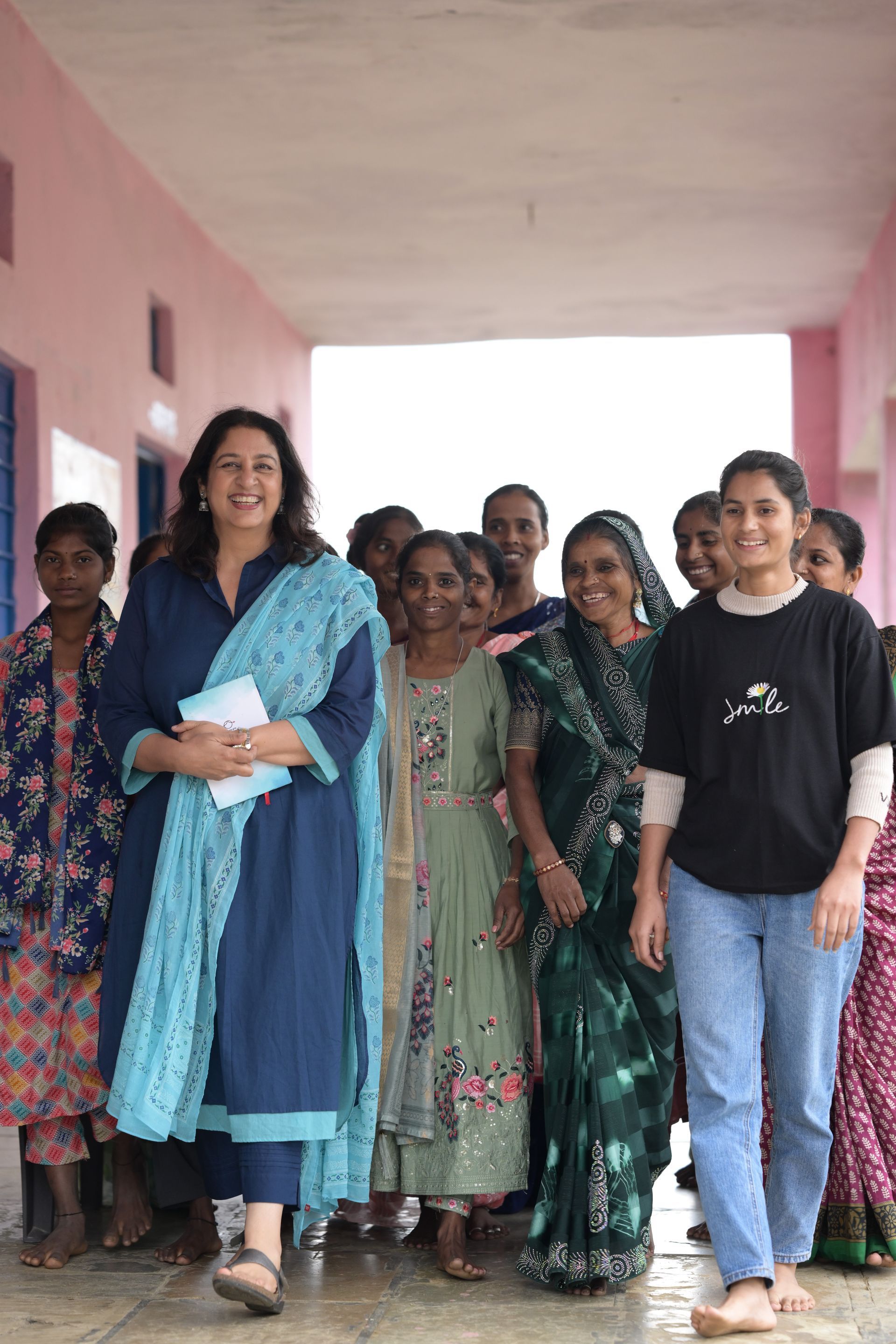
Safeena Husain • April 20, 2026
By Stefani Tieri Georges April 17, 2026
In the words of Sydney J. Harris, “The whole purpose of education is to turn mirrors into windows.” Few stories illustrate this truth more clearly than that of Ricardinio, a resilient young boy whose life was reshaped by learning, creativity, and compassionate support. Ricardinio is a displaced child living with HIV who once called the streets of Port au Prince home. When armed gangs overtook his neighbourhood, he was forced to flee, leaving behind everything familiar. The trauma of displacement, coupled with the daily realities of managing a chronic illness, left him navigating fear, uncertainty, and isolation. Everything changed when he gained access to the Resource Learning Centre at Cima Community School of Hope based in Limonade, Haïti. Within its safe walls, Ricardinio found stability, encouragement, and a sense of belonging that had been missing for far too long. The centre became more than a place of academic support; it became a catalyst for his healing. There, he discovered a surprising and transformative passion: drawing. What began as a quiet pastime soon unfolded into a powerful means of expression. Art offered him peace where chaos once lived, and possibility where hope had been fading. With guidance from mentors and access to materials he had never had before, Ricardinio started to see a future shaped not by loss, but by talent and imagination. Ricardinio learned to sew, paint and a new language, English. He made the outfit he is wearing in the photo below for a recent fashion show. His journey reminds us that for many young people, particularly those facing profound health or social challenges, that education is far more than curriculum. It is a lifeline to identity, purpose, and renewed hope. When a learning space nurtures the whole child, it turns windows toward new horizons, ensuring that even in the most difficult circumstances, every learner can envision a brighter future. BY STEFANI TIERI GEORGES Programme and Strategy Manager Sonje Ayiti, Limonade Haiti.
By Professor Nira Chamberlain April 15, 2026
Growing up in 1970s and 80s Britain, son of Jamaican immigrants, all I cared about was mathematics, mathematics and mathematics. I didn’t see the need for black role models; all I cared about was numbers. Then I reached teenage years, the opportunity to enter the educational community was not the same for people of my colour. I was being directed to become a boxer not a mathematician. A generation later my son was being pushed in the direction of singing, not a career in STEM. My story is not unique and there are many other marginalised groups. Creating an education system that genuinely includes marginalised groups isn’t just a moral imperative — it’s a practical one. When people are excluded, societies lose talent, creativity, and economic potential. So what can be done? Here are seven starters for ten: 1. Remove Barriers to Access Many marginalised learners are excluded long before they reach a classroom. Key Strategies: Eliminate financial barriers: scholarships, free school meals, subsidised transport, no-fee schooling. Provide flexible learning options: evening classes, community-based learning, mobile schools for nomadic groups. Invest in infrastructure: safe buildings, accessible facilities for disabled learners, and reliable internet in rural areas. 2. Make Learning Culturally Relevant Education becomes inclusive when learners see themselves reflected in it. What this looks like: Curriculum that includes diverse histories, languages, and perspectives. Teaching materials that avoid stereotypes and represent all groups. Community involvement in designing educational programs. Don’t just consider the marginalised groups at certain special events, but all year round. 3. Train and Support Teachers Teachers are the frontline of inclusion. Effective Approaches: Training in inclusive pedagogy and unconscious bias. Recruiting teachers from marginalised communities. Providing classroom assistants or specialists (e.g., sign language interpreters). Get teachers to be seconded in diverse areas, so they can grow to learn and appreciate different cultures. 4. Use Technology Thoughtfully, technology can widen access — or deepen inequality if used poorly. Inclusive Uses of Technology: Low-bandwidth digital learning tools for remote areas. Assistive technologies for learners with disabilities. Online platforms that allow flexible pacing and personalised learning. Keep Libraries open so that marginalised communities can access the digital world. 5. Strengthen Policies and Accountability Inclusion doesn’t happen by accident; it needs structure. I have written a paper called treating EDI as a Science Problem. It introduces Chamberlain’s Law that states this “If all things are equal what numbers do we expect to see?” On this basis, we should be able to consider things such as Anti-discrimination laws in education. Data collection on who is being left out and why. Funding formulas that allocate more resources to disadvantaged schools. 6. Engage Families and Communities There are examples where marginalised groups distrust institutions for good historical reasons. These are some of the ways to build trust: Community-led outreach programs. Parent education initiatives. Schools are partnering with local leaders, NGOs, and cultural organisations. 7. Support Learners Beyond Academics Barriers to education are often social, emotional, or economic. Holistic support: Mental health services. School meals and health checks. Safe transport and anti-bullying programs. In conclusion, these points are not comprehensive or exhaustive. However, it is a benefit to us all when education is for all. BY PROFESSOR NIRA CHAMBERLAIN OBE FIMA FORS CSci PhD HonDSc DUniv 1st AtkinsRéalis Technical Fellow for Mathematical Modelling AtkinsRéalis, Six Mathematical Doctorates. Mathematics Professor. Founder of the Black Heroes of Mathematics Conference. Science Communicator
By Ed Harlow April 13, 2026
I have always been a believer in the transformative power of education. Education can never be seen solely as a didactic pursuit. It is in many ways an act of love. Helping children to carve out their own place in the world and to understand the complexities of culture, society, history, and anthropology. Education becomes especially vital in times of conflict and unrest. When societies are divided by violence, political instability, or deep social tensions, education offers one of the most powerful tools for rebuilding communities and creating a more peaceful future. Schools are not only places where children learn academic subjects; they must be environments where values, perspectives, and skills are formed. In periods of crisis, the role of education expands beyond knowledge transmission to include fostering tolerance and equipping them with critical thinking skills that allow them to navigate complex realities. One of the most important functions of education during conflict is the promotion of tolerance and mutual understanding. Conflict often arises from fear, misunderstanding, and deeply rooted prejudices between groups. When children grow up hearing only one narrative about others, divisions can become stronger over time. Education can counteract this by exposing students to different cultures, histories, and viewpoints. Through inclusive curricula and classroom discussions, children can learn that diversity is not a threat but a natural and valuable part of human society. Teaching empathy and respect helps young people see beyond stereotypes and recognise the shared humanity in others. In the long term, these attitudes can reduce the likelihood that future generations will repeat cycles of hostility. We can see in conflict zones now that there is often a parallel battle in schools for control of the narrative. Arguments over textbooks in Palestine, for example, are longstanding with different cultural interpretations of certain themes or even individual words or pictures being used to justify political ends. Conflict can create feelings of fear, confusion, and powerlessness, particularly for young people. Schools can provide a sense of stability and normality when much of life feels unpredictable. In addition to this emotional support, education helps students understand the social, political, and historical forces shaping their circumstances. By learning about how societies function, how conflicts arise, and how they can be resolved, children gain a clearer sense of their role as members of a community and as citizens. This understanding empowers them to imagine a future beyond the conflict they are experiencing and to see themselves as participants in rebuilding their societies. Another key aspect of education in times of unrest is the development of critical thinking skills. In environments marked by propaganda, misinformation, and polarised narratives, the ability to evaluate information carefully becomes essential. This is especially vital in the modern world with the proliferation of social media, citizen journalism, and algorithms which are designed to reinforce and amplify the worldview of the user or to promote violent or extreme material. Children and young people who learn how to question sources, analyse arguments, and consider multiple perspectives are far less likely to be manipulated by extremist ideologies or false information. Critical thinking allows individuals to move beyond simplistic explanations and to recognise the complexity of social and political issues. This skill is crucial not only for personal decision-making but also for the health of democracy. Furthermore, critical thinking encourages dialogue rather than division. When students learn to examine ideas thoughtfully and listen to differing opinions, they become more capable of engaging in constructive discussions. This ability is particularly important in post-conflict societies where reconciliation and cooperation are necessary for long-term peace. Instead of reacting with hostility to disagreement, educated individuals are more likely to seek understanding and compromise. We must build education systems with this in mind. Many curricula and systems have focused on standards and testing to the detriment of true critical thinking. With the rapid onset of AI and the proliferation of algorithm-driven information access, it is more vital than ever that critical thinking, media literacy, social skills, and dialogue are placed at the heart of education and schools. While education alone cannot resolve every conflict, it lays the intellectual and moral foundations that make lasting peace possible. Investing in education during difficult times is not only an investment in individual development but also in the stability and future of entire communities.  BY ED HARLOW NEU PRESIDENT (1ST JANUARY 2026 – 31ST DECEMBER 2026) Ed has been a secondary music teacher and head of department at Highgate Wood School in London for nearly 20 years. Elected to the National Executive in 2021, and as Junior Vice-President in 2024, he has helped shape policy, taking a particular interest in restoring the arts and creative subjects in the Curriculum.