Our Students Stories Matter

In the words of Sydney J. Harris, “The whole purpose of education is to turn mirrors into windows.”


Few stories illustrate this truth more clearly than that of Ricardinio, a resilient young boy whose life was reshaped by learning, creativity, and compassionate support. Ricardinio is a displaced child living with HIV who once called the streets of Port au Prince home. When armed gangs overtook his neighbourhood, he was forced to flee, leaving behind everything familiar. The trauma of displacement, coupled with the daily realities of managing a chronic illness, left him navigating fear, uncertainty, and isolation.


Everything changed when he gained access to the Resource Learning Centre at Cima Community School of Hope based in Limonade, Haïti. Within its safe walls, Ricardinio found stability, encouragement, and a sense of belonging that had been missing for far too long. The centre became more than a place of academic support; it became a catalyst for his healing. There, he discovered a surprising and transformative passion: drawing. What began as a quiet pastime soon unfolded into a powerful means of expression. Art offered him peace where chaos once lived, and possibility where hope had been fading. With guidance from mentors and access to materials he had never had before, Ricardinio started to see a future shaped not by loss, but by talent and imagination.


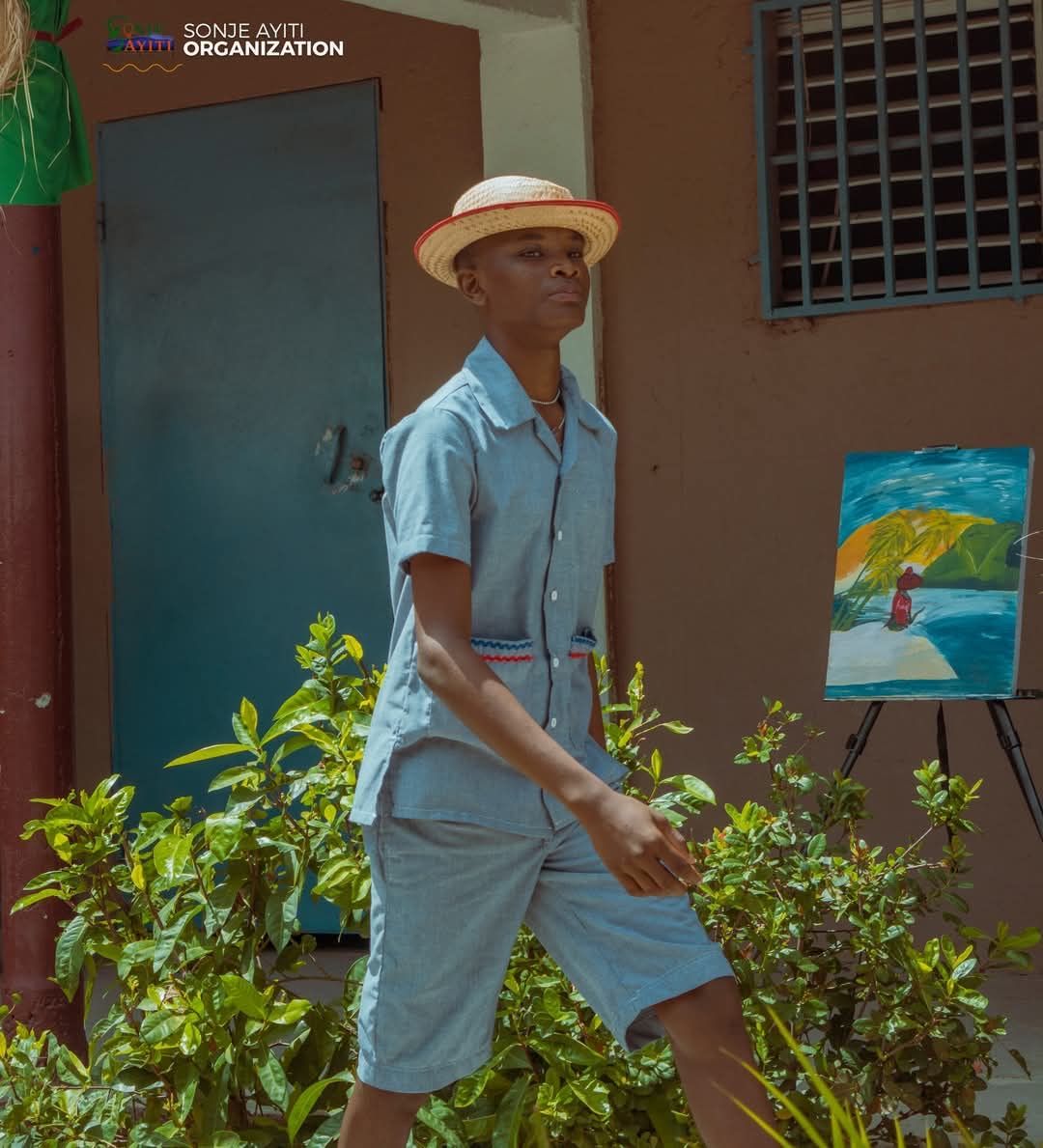
Ricardinio learned to sew, paint and a new language, English. He made the outfit he is wearing in the photo below for a recent fashion show.


His journey reminds us that for many young people, particularly those facing profound health or social challenges, that education is far more than curriculum. It is a lifeline to identity, purpose, and renewed hope. When a learning space nurtures the whole child, it turns windows toward new horizons, ensuring that even in the most difficult circumstances, every learner can envision a brighter future.


BY STEFANI TIERI GEORGES

Programme and Strategy Manager Sonje Ayiti, Limonade Haiti.
Stefani Tieri Georges • April 17, 2026
By Ann Beatty June 1, 2026
On Friday evening ( 29 May, 7.00 pm The Actors Church Covent Garden) we had the pleasure of listening to this very special concert, bringing together the Choir of King's College London and the Princeton High School Orchestra in a celebration of international friendship, collaboration, and shared values. This project reflects a commitment to peace, sustainability, equality, and cultural exchange, uniting young musicians from the United Kingdom and the United States through the universal language of music.
By Ann Beatty May 20, 2026
How a simple act of practical solidarity is transforming the journey to school in The Gambia’s Central River Region North Policies have been written. Schools have been built. Yet for many children in The Gambia’s Central River Region North, access to education is still measured in kilometres, not opportunity. 
By Laura Griffin May 13, 2026
‘In a single hour vast tracts of shaded woodland became a jumble of torn trees and upturned soil, exposed to the glare of the summer sun. Such land-clearing events are rare, but forests exhibit remarkable resilience in the face of disaster. I’m told that the Chinese character for ‘catastrophe’ is the same as that which represents the word ‘opportunity’. And, the blowdown, while catastrophic, presented opportunities for many species.’ (Wall Kimmerer, 2003: 89). In the context of a volatile, uncertain, complex, and ambiguous world (Stein, 2021) what kinds of education for hope might support children’s and young people’s critical engagement in local and global issues? In the spirit of exploring the possibilities of hope further, this short article focuses on the area of global citizenship and sustainabilityrelated education. It will briefly open by sharing commonalities across pedagogical approaches that take up the concept and act of hope more critically, and close by offering reflective questions for educators, with suggestions for further reading. Perhaps it is a kind of hope that is grounded in the present, in future reimagining(s), in ethical solidarity, and an acknowledgement of our deep entanglement with the living metabolism of planet earth 1 our singular home (UNESCO, 2021); a hope that engages with complex root causes and lived realities of multiple overlapping crises in critically reflexive and contextually relevant ways. As McCloskey notes, ‘Hope can fire our collective imagination and critical consciousness as a mainspring to activism and intervention in the world.’ (2025: 3). Commonalities across critical pedagogical approaches to hope include: Acknowledging the context of a ‘seamless single story of progress, development and human evolution’ (Andreotti, V.D.O., 2021b Relating to social and ecological justice and the wellbeing of people and planet Using participatory, action-orientated and inquiry-based learning processes Exploring diverse worldviews and perspectives Practising grounding in the present with opening up possibilities for change (relational, embodied, response-able 2 ) Experiencing ‘struggle’ in different forms (dialogical, selfreflexive, open-ended) Engaging individual and collective agency, action and activism Looking for lifelong and life-wide learning and unlearning. 1 See ‘Co-sensing with Radical Tenderness’, in Machado de Oliveira Andreotti. 2021a 2 See ‘Crossing Borders’ in 2 Depth Education “Depth Education and the Possibility of GCE Otherwise, 2021b. Source: Andreotti, V. 2021a & 2021b., Atif, A. (2025)., Bourn, D. 2021., Bryan. A. and Mochizuki,Y., 2024., Giroux, H.A. 2025., Meade, E. 2025. Whilst engaging in the concept and act of hope more critically reflect upon: What kinds of education for hope might you explore further and why? How might you provide generative spaces for engaging in diverse worldviews and perspectives? In what ways can you facilitate individual and collective agency? How might you support learners’ practice grounding in the present in order to relate differently? In what ways can you support learners in navigating complex root causes and lived realities of local and global issues? As Chief Ninawa Hini Kui affirms, ‘The future depends much less on the images we project ahead than on our capacity to repair relations and build relationships differently in the present.’ (Andreotti et al, 2023: 73. An invitation for further reading: Transformative Learning for a Sustainable Future . d’Abreu, C., Belgeonne, C., Bourn, D. and Hatley, J. (2025) ‘Transformative Learning for a Sustainable Future’. DERC Research Paper 24. London: UCL Institute of Education. Hospicing Modernity: facing humanity’s wrongs and the implications for social activism. Machado de Oliveira Andreotti, V. (2021a) ‘Hospicing Modernity: facing humanity’s wrongs and the implications for social activism’ , London: Penguin Random House. Development Education and Hope . McCloskey, S. (2025). (ed) ‘Development Education and Hope’. ‘Policy and Practice: A Development Education Review’ , Vol. 41, Autumn. Centre for Global Education, Belfast. Link to and download the full reference list here