Soroptimist Ann Beatty’s First-Time Experience of CSW in New York

On Monday 27 April 2026 we heard first-hand about the United Nations Commission on the Status of Women 2026, CSW70, with the theme “Ensuring and strengthening access to justice for all women and girls”. 

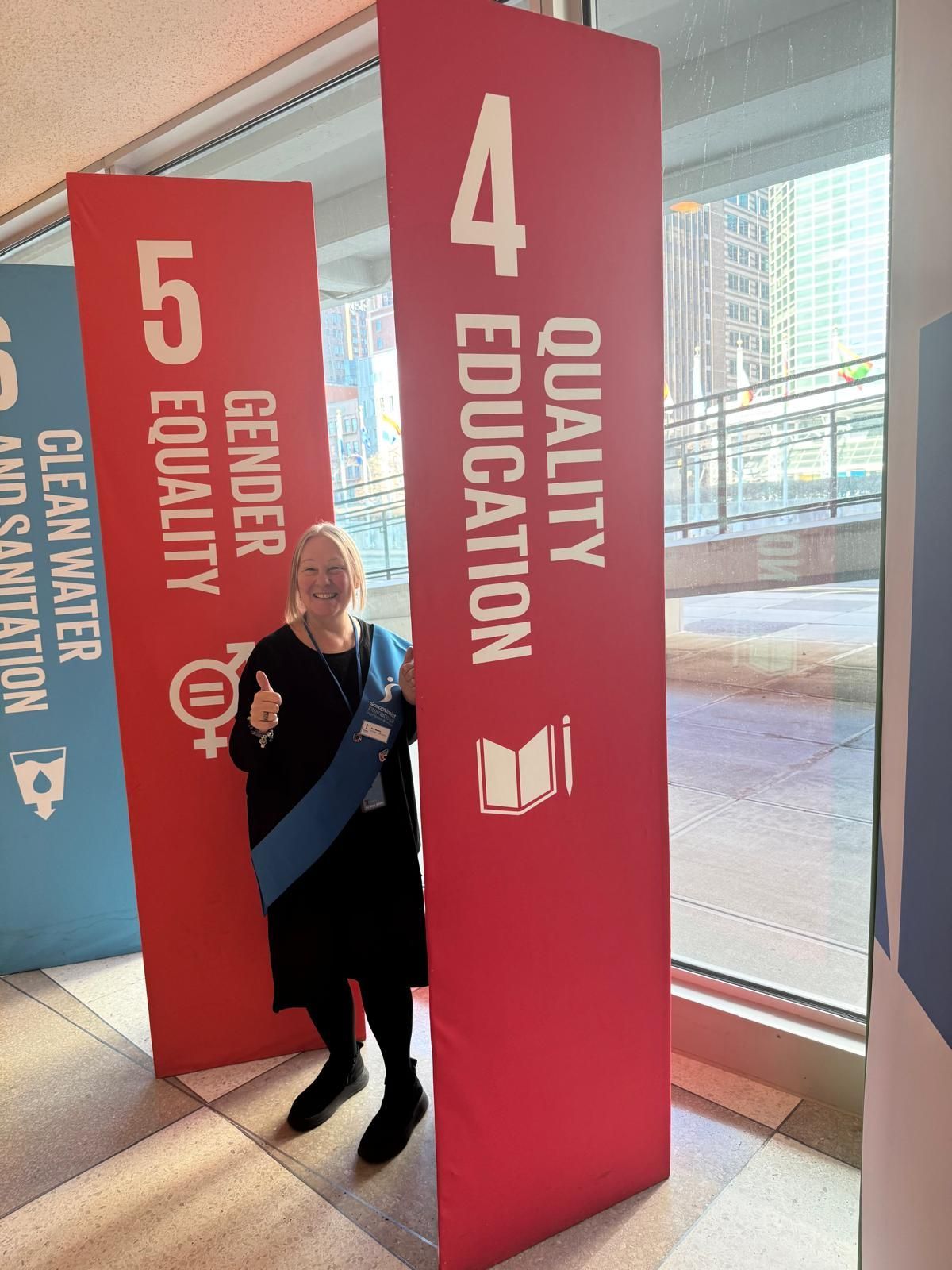
Ann Beatty is a member of Soroptimist International St Albans & District and also the Chief Executive of the education charity the Steve Sinnott Foundation. Ann attended CSW69 on-line last year, and this year attended CSW in person for the first time (see photo) as one of the delegates from Soroptimist International Great Britain and Ireland.


Barbara Saunders OBE welcomed everyone to the meeting which coincided with the Club’s 69th Anniversary. She said it was wonderful to have so many guests from far and wide. Barbara introduced Ann with much anticipation and emphasised the importance of gender equality and education.


Ann then shared with the audience her 10-day experience of attending the UN Commission on the Status of Women (CSW) in New York in March. Ann attended as part of the Soroptimist International Great Britain and Ireland delegation and also represented the Steve Sinnott Foundation. She described the overwhelming nature of the event with hundreds of parallel events and side meetings. She discussed the political debates around women’s rights, particularly regarding US attempts to roll back agreed conclusions, and highlighted her participation in events focusing on education, Haiti, and intersex issues. The discussion included questions about the effectiveness of CSW, the representation of different voices, and the influence of various organisations at the UN. Participants shared insights about the challenges of navigating the complex UN system and the importance of networking with other like-minded organisations working toward gender equality and education for all.


You can click here to view Ann’s slides Ann Beatty SIGBI CSW70 2026 and click here to watch the recording of the event on Youtube: https://youtu.be/cxYQM2d0waA 


Ann said how positive it was to network with other women and organisations working on various UN Sustainable Development Goals and she has been in contact with many subsequently. She discussed the debate around the proposal to merge UN Women and UNFPA which was negatively received by delegates. Ann highlighted the importance of networking and collaboration among attendees, and mentioned specific events she attended, including a session on barriers to education. She also touched on the challenges of the conference, including the overwhelming number of events and the high costs, while emphasising the value of connecting with like-minded individuals to further their shared goals.
Barbara and Ann discussed the differences between attending UN events in person versus online, with Ann stressing that the in-person experience provides much richer interaction and networking opportunities despite being more costly and exhausting. Ann shared her observations about the CSW (Commission on the Status of Women) discussions, particularly noting tensions around US efforts to roll back women’s rights agreements from 1946, though she cautioned about the complexity of the situation and recommended reading the official CSW conclusions for a complete understanding. Jane added context about the specific issues at stake regarding diversity, gender, and reproductive rights.
Ann shared insights, including learning about intersex issues and the challenges faced by individuals whose gender assignments were incorrect at birth (1.7 % – nearly as many as twin births). When asked about CSW’s effectiveness, Ann expressed that while there are gaps in representation, particularly for less resourced organisations, the presence of diverse voices is important for progress. St Albans Soroptimist Liz Tillett, who had worked with the UN in the past, noted that the real test of CSW’s impact would come at the UN General Assembly in September, where decisions made at lower levels get filtered up for potential implementation by heads of government.
The group also discussed the complexity of coordination among different women’s organisations and across the delegates from the different Soroptimist Federations.
There were lots of appreciative gestures and comments from everyone who attended.
Barbara Saunders closed the meeting, thanking Ann for agreeing to share her experiences with such candour. She said it must have has taken Ann time to synthesise the experience of the chaos, and turn it into an event which has been very memorable, informative and enlightening. Barbara said she understood the value of mixing with people from a wide variety of backgrounds, different levels of development and ways of working, bringing benefits in understanding that can’t be measured in financial terms. She ended by saying to Ann “Keep up your amazing work!”.


Soroptimist International has consultative status at the United Nations – click here to find out more https://sigbi.org/what-we-do/soroptimists-and-the-un/


The seventieth session of the Commission on the Status of Women took place from 9 to 19 March 2026. The priority theme of the session was: Ensuring and strengthening access to justice for all women and girls, including by promoting inclusive and equitable legal systems, eliminating discriminatory laws, policies, and practices, and addressing structural barriers. The review theme was: Women’s full and effective participation and decision making in public life, as well as the elimination of violence, for achieving gender equality and the empowerment of all women and girls.


Click here to read more: https://www.unwomen.org/en/how-we-work/commission-on-the-status-of-women/csw70-2026

Ann Beatty • April 27, 2026
By Susan Piper May 6, 2026
This summed up to me about why I volunteer for the Hands Up Project. HUP is a charity trust which, through its network of volunteers, connects children around the world with young people in Palestine. By means of online interaction, drama and storytelling activities, it enables the use of creativity and selfexpression to promote mutual understanding, personal growth, and the development of English language skills. I joined HUP in 2020 during COVID. After going to Palestine in 2017, I wanted to get more involved in working with Palestinian children in schools. HUP gave me the opportunity to link up with schools in the West Bank and Gaza. Every week I’d tell them stories from all over the world, then we’d discuss it, play games and I’d get them to retell it. Sometimes we would work from their coursebook English for Palestine’ in mutual team teaching sessions with their teacher. The simple act of telling a story became much more than entertainment. It became connection, healing, and a bridge to the world beyond their immediate reality to help them improve their language skills, and to give them a platform to speak about their lives in a language that connects them to people everywhere. I loved it, every week, seeing their smiling faces on the screen and building long lasting friendships with their teachers. I even went to Gaza in 2023 and met some of the kids I’d only seen on Zoom. It was a beautiful experience and something I will never forget. As hostilities escalated, I lost contact with everyone. I thought about where the kids were and what had happened to them. As I watched schools being bombed, universities flattened, and people killed in their thousands, I thought about where the kids I’d met were and what was happening to them. I kept in contact with many of the teachers I knew and heard daily news of displacement, destruction, hunger and bombing. Recently, I’ve started to link up again with children in Gaza, and it feels wonderful to be back helping them learn after being denied an education for over two years. Connecting with children in Palestine is more than just words. When a child in Palestine confidently tells their story to someone on the other side of the world, bridges are built, empathy grows, and the world gains a fuller picture of childhood in contexts far from peace and privilege. My work with these children is rooted in the belief that education and voice are inseparable. Through storytelling and English language learning, I witness children not just learning new vocabulary, but reclaiming their narratives, believing in their potential, and finding human connection in a world they perceive has abandoned them. And more than anything, this work reminds us all that children — everywhere — deserve to learn, to speak, and to be heard. Links to HUP information, books and resources: The Hands Up Project BY SUSAN PIPER Susan Piper is currently an ESOL teacher in Oldham, Greater Manchester and has worked in education for over 30 years. She is also a volunteer for the Hands Up Project and is the International Solidarity Officer and President of her NEU district. She believes in quality education for all and aims to make her lessons creative and inclusive so that effective language learning can take place.
By Andy Harvey May 4, 2026
Small children play contentedly side by side. From time to time, a toy is snatched, a child is pushed, a whine of protest arises. The teacher’s voice is steady and encouraging: use your words, not your hands; wait your turn. There will be an emotional meltdown at some point, but soothing adult words settle it quickly. Upstairs a clutch of nine-year-olds hover over a maths problem. One girl insists she knows a quicker way that she learned on social media; her friend is adamant they must stick to the method they were taught. The teacher looks on approvingly. In a nearby room, a child dabs their eyes with a tissue while a teacher speaks softly and leans in close, offering reassurance. Meanwhile, in the hall, the older children are debating government spending on overseas aid. It’s getting heated. They speak their mind and defend their views passionately: what they have heard people say, what they have seen online. The teacher intervenes, pointing to the ground rules projected on the wall: think before you speak, your words can hurt others. A pause, and then the debate surges back to life. Schools are not, and have never been, conflict-free zones: they are shaped by the pressures and tensions that exist in their communities. Besides their schoolbag, children carry the weight of personal trauma, family conflict, poverty and a kaleidoscope of influences, good and bad, through the school gates each day. Teachers and other school staff are also inscribed in conflict, as they confront the challenges of poor wellbeing, inequality and harmful social attitudes, with increasingly constrained resources. Of course, school education itself is the subject of conflict. Access to free universal education for all children has rarely been simply granted; it has been struggled for over time, and for some children remains precarious or denied altogether. But the vignettes above reveal the powerful role education can play in a world bedeviled by conflict. Children in the Early Years Setting are learning life’s first lessons: to share resources, to respect others’ space and belongings, to negotiate and to regulate emotions. The older children might be frustrated by rules that do not suit themselves personally, and others may easily forget them in the heat of the moment, but there is a collective appreciation of why the rules exist, and an understanding that the world extends beyond our own thoughts and interests and that empathy, compassion and respect are key to personal realisation and to group harmony. None of this happens by accident. It is the result of consistent, structured, professional teaching, reinforced by a nurturing homelife. It depends on adults setting boundaries with children, modelling respect, building emotional literacy, helping children understand consequences of actions and stepping in when things go wrong. What looks effortless from the outside is the outcome of daily effort. It has so much more chance of success when it is well-resourced. In Scotland, we have a curriculum that aspires for children to be successful learners, confident individuals, effective contributors, and responsible citizens. Despite its imperfections in implementation, it is a powerful declaration that education must be about more than academic attainment: it’s about nurturing and shaping the people who will have to confront challenges - personal, social, and global - which previous generations could barely have imagined. In the past year, the Educational Institute of Scotland (EIS) has collaborated with partners to develop tools for teachers to counter the effects on children of online hate. We have also supported a key project to tackle misogynistic attitudes and behaviours which are perpetuated among young people by online content and algorithms. Alongside the development of our Education for Peace policy, EIS members have engaged in the strengthening of Scotland’s Learning for Sustainability strategy to enhance the way our children relate to each other and to the natural world around them. All of this is important work in addressing conflict. However, we should never forget the criticality of the learning and teaching that goes on every day, and the importance of resourcing it properly in our nursery classes, our primary, secondary and special schools. In a world scarred by conflict, this is the quiet and healing work of hope. BY ANDY HARVEY National Officer, Educational Institute of Scotland
By Hedi Argent April 29, 2026
The aim of Holocaust education should never be to introduce young people to the details of the horrors of the Holocaust, but to help them to understand how it could happen: what led up to it, and to recognise how conspiracy theories, fake news and disinformation lead to prejudice. And how prejudice leads to racism – and when racism is allowed to flourish, then there is no limit to what can happen. I give talks mainly to students in Year 6 who are in the last class of primary school. They are good listeners and generally uninhibited about interacting and asking searching questions. Some talks inevitably have to be on Zoom because of unmanageable distances, but there is an advantage because several schools can participate and I have spoken to as many as 500 children in one session. With a bit of technical luck, I can see them and they can see me as well as PowerPoint illustrations. I talk about my own experiences as a child and how my cousin and I became the targets of racism and learned how antisemitism, surely the oldest form of racism, felt as well as what it meant. Our stories had very different outcomes: I was lucky and survived. I came to England with my parents. We discuss what refugees may bring with them and what and who they must leave behind and how that may feel. I encourage them to listen to others’ stories and to tell their own – we all have stories to tell and they help us to welcome strangers, not to fear them. My cousin was not lucky. He was one of six million who were not lucky. The children and I explore together what 6,000,000 means. We stand and I tell them that the late Chief Rabbi of the UK, Lord Jonathan Sachs, once worked out that if we stood for just one minute to commemorate each of the 6,000,000 we would be standing in this place for 11 years and 4 months. We talk about who can do such things? and I stress that there are no bad people but only people who do bad things. I give examples of kindness: a child who played with me when the other children and teachers in my school shunned me and called me names, a man in the Nazi party, who knew and saved my father when he was arrested, and a doctor who took me to hospital, where Jews were not allowed, when I nearly lost a finger. Eli Wiesel, an author, who witnessed the worst terrors of the Holocaust as a child in the camps, once said that when we tell our stories, we share the responsibility of being a witness and when enough of us become witnesses we may never let it happen again. BY HEDI ARGENT Hedi and her parents came to England as refugees from Austria in 1939. Hedi spent most of her working life in Social Work specialising in the adoption of older children and children with disabilities. She has written and edited more than twenty books on the subject and is still working and speaking in schools about the Holocaust and what it means to be a refugee. Hedi has recently written her own story and has donated the royalties from her book sales to the Foundation. She is also an ambassador for the Foundation.